Mobile App Development – Android & iOS Professional Solutions
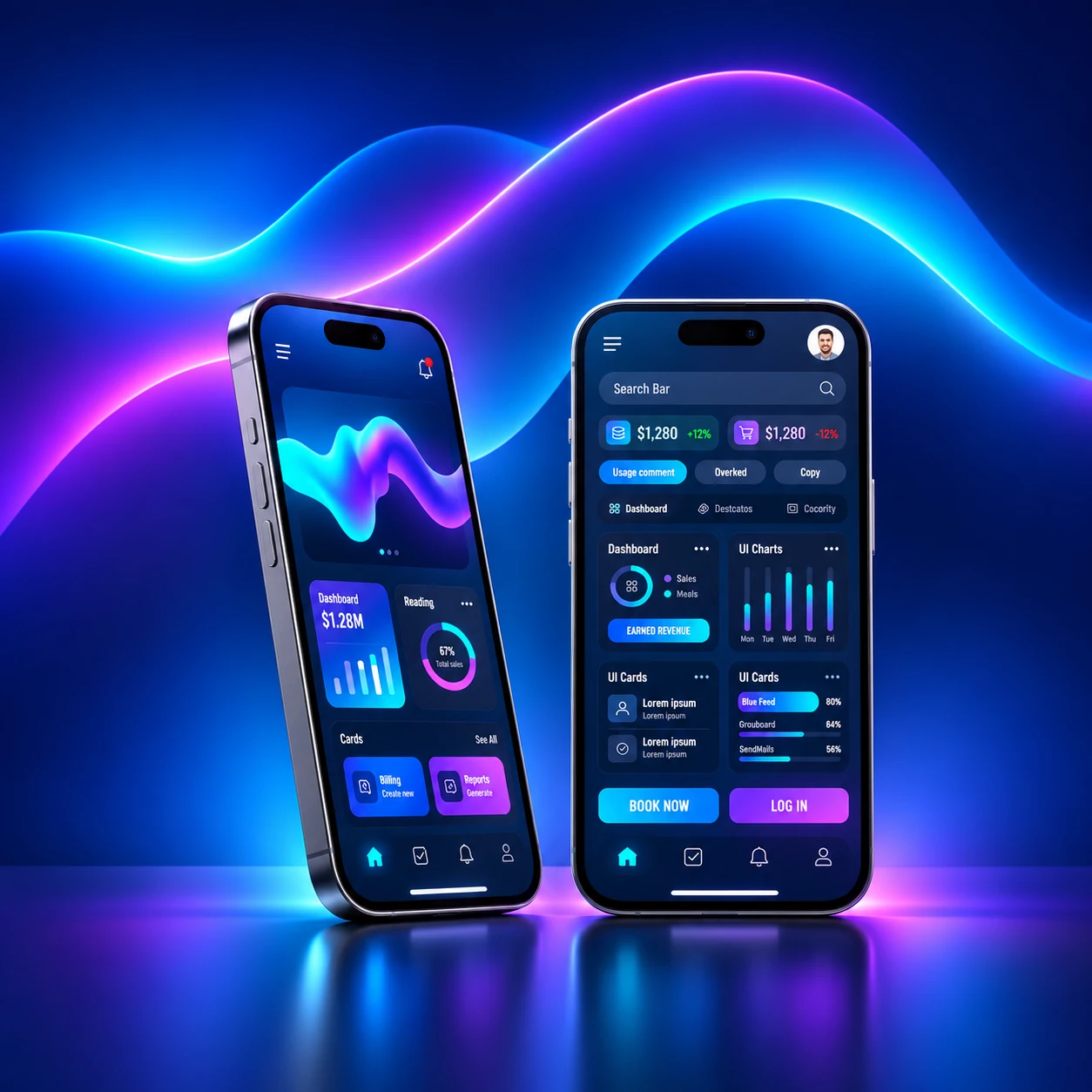
We turn your vision into high-performing mobile applications. We build intuitive, scalable, and beautifully designed iOS and Android apps tailored specifically to your business requirements.
Smartphones have become an indispensable part of everyday life. People shop, book services, make secure payments, manage reservations, and access essential data through mobile apps. For modern enterprises, this opens an unprecedented opportunity to build long-term relationships with customers and offer services in an instant, convenient format.
Today, owning a dedicated mobile application is no longer restricted to tech conglomerates. Growing companies, retail e-commerce stores, service providers, and early-stage startups can leverage mobile apps to offer frictionless customer experiences and outpace competition.
At Codemark, we provide mobile app development engineered around your exact commercial needs. Our goal is not just releasing software to stores; we create apps your users genuinely love using and your internal team can manage effortlessly without technical friction.
Whether you are expanding an existing business with a companion mobile app or launching a groundbreaking digital startup, we manage every phase from strategic architecture to App Store and Google Play publishing.
Native and cross-platform development for Android and iOS, bespoke UI/UX design, cloud backend systems, real-time API integrations, and robust admin dashboards are all tailored to your project requirements.
Ready to develop your mobile app? Share your idea or business workflow with us. Together, we will define the feature roadmap, ideal technology stack, and delivery milestones.
Why Is a Mobile App Critical for Your Business?
A website is essential for prospective customers to discover your brand and evaluate your offerings online. A mobile app, on the other hand, builds continuous, high-retention engagement with your most active clients.
If customers interact with your products or services on a recurring basis, tapping an app icon on their home screen is vastly faster and more intuitive than opening a browser and navigating to a website.
Booking services, courier deliveries, retail e-commerce stores, and member-based portals gain immense strategic value from dedicated mobile platforms.
One of the foremost strengths of mobile applications is personalization. Customers can instantly view historical orders, repeat past transactions in one tap, save multiple delivery addresses, and manage their preferences seamlessly.
Direct communication through push notifications is another superpower. You can alert users instantly about order dispatches, price reductions, exclusive campaigns, and upcoming calendar appointments, yielding engagement rates far superior to email.
Mobile applications also streamline internal corporate workflows. Field agents can capture inspection reports, delivery teams can update statuses in real time, and warehouse workers can scan inventory directly from company-issued handheld devices.
However, a mobile app is not mandatory for every business model. In certain cases, a responsive web application can achieve your objectives with lower initial investment and simpler maintenance.
That is why we evaluate your business model thoroughly before development to confirm that a native mobile app is indeed the most profitable digital investment for you.
What Do We Focus on During Mobile Development?
The hallmark of an exceptional mobile app is not overwhelming the user with dozens of complicated menus. The true test of quality is how effortlessly users accomplish their primary intent.
From the moment the app opens, its purpose must be immediately obvious. Users should never be subjected to convoluted registration forms, confusing navigations, or ambiguous checkout sequences.
In an e-commerce app, locating an item, adding it to the bag, and completing payment should take mere seconds. In a booking platform, selecting dates and confirming appointments must be fluid and intuitive.
This is why we place user experience (UX) architecture at the very center of our development lifecycle.
Visual aesthetics, screen hierarchies, button tap ergonomics, data fetching speeds, and backend logic must operate in perfect harmony.
Simultaneously, future architectural expansion must be anticipated. While your launch version may require core MVP features today, you will likely need automated loyalty tiers, multi-currency payments, or new roles within 12–24 months.
Planning for modularity in early sprints prevents costly refactoring later on.
What Types of Mobile Apps Do We Build?
Every business operates under unique requirements and serves distinct customer demographics. Imposing a rigid template on varied industries yields poor results.
At Codemark, our mobile applications are custom-engineered around specific strategic outcomes, operational models, and required technical integrations.
E-Commerce & Retail Apps
If you retail products online, a dedicated mobile application gives your customers a faster, more engaging shopping experience that drives repeat orders.
Shoppers can browse curated categories, filter by specifications, compare variants, bookmark wishlists, and complete purchases with saved cards or Apple Pay / Google Pay.
Features like order history, real-time shipment status, multi-address management, and push alerts for flash sales significantly boost customer lifetime value.
If you operate an active web store, we synchronize the mobile app with your existing backend database so inventories and orders remain unified across all channels.
On-Demand Ordering & Delivery Apps
For businesses centered around dispatching physical goods — groceries, bottled water, dry cleaning, or express courier services — mobile apps automate end-to-end logistics.
Customers select products, specify exact pin-drop locations on interactive maps, and dispatch requests effortlessly.
We engineer role-based ecosystems comprising customer apps, dispatcher control panels, and specialized courier apps that route deliveries and update progress in real time.
Live GPS courier tracking, order phase notifications, and automated SMS alerts keep all parties synchronized without manual phone coordination.
Restaurant & Hospitality Apps
Restaurants and hospitality chains utilize mobile apps to foster direct patron loyalty, bypass third-party aggregator commissions, and streamline orders.
Interactive visual menus, table reservations, takeout pre-orders, and integrated bonus stamp cards incentivize frequent visits.
For multi-venue restaurant groups, we provide branch locators with driving directions and independent kitchen printer routing per location.
Direct push notifications about chef specials and seasonal promotions ensure high recurring foot traffic.
Booking & Appointment Apps
For appointment-based businesses — beauty clinics, fitness studios, medical practices, car rentals, and tutors — booking apps eliminate scheduling friction.
Clients view live specialist availability, select service packages, choose time slots, and pay deposits securely in seconds.
Automated appointment push reminders reduce no-shows dramatically, while calendar rescheduling options provide complete convenience.
Bulletproof backend concurrency locks prevent double-booking across specialists and venues.
Enterprise & Workforce Apps
Mobile apps are equally transformative for streamlining internal corporate operations and field worker efficiency.
We engineer secure apps for field technicians, sales representatives, and logistics teams to log task statuses, capture digital client signatures, and submit reports on the go.
Deep bi-directional integration with your internal CRM, ERP, and inventory management systems eliminates paperwork and manual data entry.
Role-based permissions (RBAC) ensure that staff members access only data relevant to their specific department and responsibilities.
Startup MVPs & Product Platforms
When launching a disruptive digital startup, building every theoretical feature upfront is both risky and capital-inefficient.
We specialize in crafting Minimum Viable Products (MVPs) that validate core user value propositions quickly and cost-effectively.
We focus on the essential workflows that gather immediate user feedback and prove product-market fit before allocating capital to secondary capabilities.
Our scalable software architecture ensures that when your startup secures traction or funding, your codebase expands seamlessly without requiring a ground-up rebuild.
Android Application Development
Android powers billions of smartphones and tablets worldwide across numerous manufacturers and hardware configurations.
When developing for Android, accommodating varied screen aspect ratios, processor tiers, and OS versions is critical for delivering a consistent experience.
We ensure navigation structures, fluid animations, push notifications, and background processes run reliably across Samsung, Xiaomi, Google Pixel, and other popular Android devices.
We fully handle Google Play Console registration, technical compliance checks, 64-bit app bundle packaging, and store review requirements.
iOS Application Development (iPhone & iPad)
Apple's iOS platform demands the highest standards of interface refinement, fluid responsiveness, and user privacy protection.
We engineer iOS applications that adhere strictly to Apple's Human Interface Guidelines, leveraging native gestures, haptic feedback, and modern Swift/React Native patterns.
From Face ID biometric authentication to Apple Pay integration and App Tracking Transparency compliance, every technical requirement is satisfied.
We guide your team through Apple Developer Program enrollment and manage the App Store review process until your app is officially approved and live.
Unified Cross-Platform Development (React Native)
One of the most frequent dilemmas clients face is deciding whether to build independent codebases for iOS and Android or utilize a unified cross-platform framework.
Modern technologies like React Native enable engineering both iOS and Android applications from a single, shared codebase without compromising native look, feel, or speed.
This unified approach reduces upfront development costs by up to 40% and allows feature updates and bug fixes to deploy across both platforms simultaneously.
For workloads requiring intense hardware computation, augmented reality, or proprietary low-level drivers, full native modules can be integrated directly where required.
Mobile UI/UX Design & Ergonomics
First impressions in a mobile app are formed within seconds. Outstanding design goes beyond eye-catching aesthetics — it governs how effortlessly users navigate and achieve their goals.
We map out complete user journeys, eliminating unnecessary friction points and ensuring key buttons are positioned comfortably within natural one-handed thumb zones.
What Is UI Design?
UI (User Interface) encompasses the visual components of your application: brand color palettes, typography, interactive buttons, custom icon sets, data cards, and screen transitions. Our UI design reflects your distinct corporate identity while ensuring maximum readability on high-density OLED displays.
What Is UX Design?
UX (User Experience) defines how intuitive, fast, and satisfying the app feels to navigate. How easily can someone find a product? Is checkout achievable in three taps? How forgiving is the input validation? Rigorous UX prototyping guarantees zero user frustration.
At Codemark, UI and UX are conceived as unified pillars of the overall product architecture, ensuring your app is as practical and enjoyable to use as it is aesthetically striking.
Backend Architecture & Cloud API Systems
The visual screens on a smartphone represent only the front-facing layer of a mobile application.
Behind every dynamic interaction lies a robust cloud backend that handles user authentication, data queries, transactional logic, payment webhooks, and push notifications.
If the backend architecture is fragile or poorly optimized, even the most gorgeous mobile interface will suffer from lag, timeout errors, and dropped orders.
We engineer scalable RESTful and GraphQL APIs utilizing high-performance frameworks like Laravel and Node.js. For complex enterprise workflows requiring proprietary database logic, we apply our specialized custom software development standards to guarantee bank-grade reliability and linear scalability.
Centralized Web Admin Dashboard
To run your mobile platform effectively, your operational staff requires an intuitive desktop management portal.
You shouldn't have to alter code to update product prices, approve customer accounts, or review real-time transactions.
We build responsive, secure web dashboards that allow your administrators, dispatchers, and managers to monitor incoming orders, broadcast push campaigns, view analytical charts, and update content in real time.
Role-based access controls (RBAC) ensure that managers, support staff, and accountants see only the tools and data relevant to their responsibilities.
Seamless Integration with Existing Websites & Systems
If your business already operates a website or ERP system, you do not need to duplicate catalogs or build siloed databases for your mobile app.
We engineer API connectors that synchronize products, stock levels, order queues, and customer accounts bi-directionally between your website and mobile application.
A customer who creates an account or saves items on your website can sign into the mobile app and immediately find their profile and purchase history ready.
Our engineers evaluate your existing infrastructure during discovery to identify the cleanest, most efficient integration architecture.
What Capabilities Can Be Integrated into Your App?
A mobile application's feature set is dictated by its core commercial purpose.
Whether you need rapid checkout, real-time geolocation, or smart automated recommendations powered by our cutting-edge AI solutions, we implement features that deliver measurable business results.
User Profiles & Fast Onboarding
Frictionless registration via phone OTP verification, Apple Sign-In, or Google authentication. Users manage personalized profiles, favorite items, and saved addresses effortlessly.
Targeted Push Notifications
Direct notification triggers via Firebase (FCM) and Apple APNs for transactional order updates, abandoned cart reminders, and segmented marketing broadcasts.
Secure Online Payments
Frictionless in-app checkout via local bank acquiring gateways, international processors (Stripe), Apple Pay, and Google Pay with strict 3D Secure compliance.
Maps & Real-Time Geolocation
Interactive Google Maps and Mapbox integrations for accurate delivery pin drops, branch navigators, radius searches, and live driver tracking.
Camera, QR Scanning & Uploads
Native camera access for instant barcode/QR scanning, photo verification, profile pictures, and secure PDF receipt and document uploads.
Multilingual Localization (i18n)
Seamless language switching across English, Azerbaijani, Russian, and international locales with dynamic currency and date formatting.
Deep CRM, ERP & External API Integrations
Automated data synchronization with enterprise back-office software (1C, Bitrix24, Salesforce), transactional email services, WhatsApp Business APIs, and SMS gateways.
You do not need to pack every capability into your inaugural launch. Prioritizing high-impact features for your initial release allows you to launch faster and iterate based on real feedback.
Mobile App Performance & Sub-Second Responsiveness
Mobile users expect instant responses. Sluggish screen transitions, frozen buttons, and battery-draining background loops lead to immediate uninstalls.
App performance is governed by code efficiency, data pagination, background caching, image compression, and server query optimization.
We engineer intelligent client-side caching so users can view previously fetched catalogs even during temporary network interruptions.
Every release is profiled for memory usage, CPU consumption, and battery footprint across physical devices.
Enterprise Security, Biometrics & Data Protection
Mobile apps store confidential customer profiles, phone numbers, delivery addresses, and payment records. Security cannot be an afterthought.
We enforce SSL/TLS encrypted traffic, secure token storage via Apple Keychain and Android Keystore, OAuth 2.0 / JWT session validation, and strict API rate limiting.
Role-based permissions guarantee that a user cannot access another customer's data or orders under any circumstance.
Continuous security audits and prompt dependencies patching keep your platform resilient against emerging digital threats.
How Does the Mobile App Development Lifecycle Work?
Building a world-class mobile app requires disciplined coordination between business analysts, UI/UX designers, mobile engineers, backend architects, and QA testers.
At Codemark, every project moves through a structured, predictable 8-stage delivery framework.
1. Business Discovery & Concept Workshop
We begin by understanding your business model, customer pain points, and commercial objectives.
Who are the target personas? What core problems does the app solve? What does success look like?
We analyze competitive apps and benchmark user expectations across your target markets.
Core functional priorities, budget guidelines, and tentative timelines are established.
2. Technical Specification & User Journeys
We define every user story, screen flow, database schema, and integration endpoint in a detailed scope.
From onboarding to checkout, every edge case and error state is systematically mapped out.
A precise functional specification prevents ambiguities and ensures transparent milestone tracking.
3. UI/UX Design & Clickable Prototyping
Our designers create high-fidelity Figma prototypes representing the full visual user interface.
Color systems, typography, micro-interactions, dark mode palettes, and responsive layouts are finalized.
You test a clickable prototype directly on your phone to validate user experience before coding begins.
4. Mobile App Engineering
Our mobile engineering team translates approved Figma designs into clean, modular production code.
Interactive screens, navigation transitions, local data stores, and device sensor hooks are built.
We employ modern React Native or native architectures for maximum responsiveness and maintainability.
5. Cloud Backend & Admin Dashboard
Simultaneously, our backend engineers build secure cloud APIs, databases, and operational dashboards.
Payment gateways, SMS verifications, and CRM integrations are connected to the central server.
Strict security validations and transactional integrity checks are put into place.
6. Multi-Device QA & Rigorous Testing
Our QA specialists execute comprehensive functional, performance, security, and battery impact tests.
Testing is conducted across real physical iOS and Android devices, varied screen resolutions, and OS versions.
Payment flows, push notifications, offline modes, and slow-network behaviors are rigorously verified.
7. App Store & Google Play Launch
We manage the entire submission lifecycle on Apple App Store and Google Play Console.
We prepare app descriptions, metadata, localized keywords, compliance forms, and high-res store screenshots.
We shepherd your application through platform review audits until official store approval is granted.
8. Continuous SLA Support & Scaling
Publishing your application is the beginning of its commercial life cycle.
We monitor server uptime, provide OS compatibility updates for new iOS and Android releases, and fix bugs.
As your customer base grows, we help roll out new feature sprints and continuous product enhancements.
Google Play & Apple App Store Publishing Protocols
Navigating the strict submission requirements of Google Play and the Apple App Store requires specialized technical experience.
Both platforms enforce stringent guidelines regarding privacy policies, account deletion capabilities, third-party libraries, and in-app purchase compliance.
Apple and Google reviewers evaluate apps thoroughly, and improper technical packaging can lead to rejected submissions and launch delays.
At Codemark, store publishing assistance is an integral part of our delivery commitment. We guide your team through account configurations and oversee review communications until full approval.
Data-Driven Iteration & Post-Launch Evolution
A successful digital product continues to evolve based on how real customers use it in the real world.
By integrating mobile analytics, you track conversion drop-offs, most frequently used features, and user navigation trends.
These empirical insights inform your product backlog, ensuring future updates address real customer needs and optimize revenue generation.
Continuous technical refinement keeps your mobile app competitive, secure, and aligned with company growth.
What Factors Determine Mobile App Development Pricing?
Cost is naturally one of the foremost considerations when planning a mobile initiative.
However, quoting an arbitrary flat fee without analyzing requirements is impossible because architectural complexity, integrations, and screen counts vary dramatically across projects.
A straightforward informational app requires a vastly different engineering investment than a multi-tier delivery system with live GPS tracking, payment gateways, and dispatcher dashboards.
Mobile app development pricing is primarily driven by functional scope, platform targets (iOS/Android), UI complexity, backend architecture, and third-party integrations.
Functional Scope & Complexity
The number of interactive workflows — registration, booking engines, cart checkouts, and custom calculators — directly governs development and QA hours.
Platform Targets
Supporting both iOS and Android via a shared cross-platform codebase provides tremendous cost efficiency compared to building and maintaining two completely isolated native teams.
UI/UX Depth & Screen Count
Bespoke visual design systems with custom micro-animations and unique component states require more creative hours than standardized layout patterns.
Backend Architecture & Admin Panel
Complex transactional logic, relational databases, webhooks, and custom web admin dashboards represent a substantial portion of overall product engineering.
External Integrations
Integrating bank payment gateways, real-time map APIs, SMS services, and ERP/CRM connections involves specialized protocol configurations and test matrices.
Ongoing Infrastructure & Support
Beyond initial coding, developer accounts ($99/yr Apple, $25 Google), cloud server hosting, and SLA maintenance agreements are transparently planned into the budget.
At Codemark, we believe in transparent, value-based pricing. By prioritizing essential features for your initial release, your capital is deployed with maximum efficiency and high return on investment.
Want to receive a detailed cost estimate for your mobile application? Share your vision and feature priorities with us today.
How Long Does It Take to Build a Mobile App?
Development timelines correlate directly with functional scope and architectural complexity.
A focused MVP application typically requires 6–8 weeks, whereas a multi-role enterprise platform with complex integrations spans 3–5 months or more.
Having clear business requirements and prepared branding assets significantly accelerates project velocity.
We provide fixed sprint schedules and milestone deliverables during discovery so your launch timeline is dependable.
Mobile App vs. Responsive Mobile Website?
A responsive website lives on the web, easily discovered by new visitors via Google search. It serves as your primary marketing and lead-generation portal.
A mobile app, however, resides on your customer's home screen. It offers sub-second load times, instant biometric authentication, push notifications, and direct offline utility.
For companies looking to cultivate long-term customer loyalty and streamline frequent repeat purchases, mobile apps generate substantially higher lifetime retention.
The most successful digital brands leverage both: a fast website to acquire new customers, and a mobile app to retain and monetize them.
App Store Optimization (ASO) & Marketing Visibility
Launching your app on Google Play and the App Store is only the starting line. Users must be able to discover and download it organically.
App Store Optimization (ASO) focuses on maximizing store discoverability through strategic keyword targeting, compelling iconography, high-converting preview screenshots, and localized descriptions.
Combined with multi-channel marketing across your website, social media, and digital campaigns, effective ASO drives steady organic app installations.
App Modernization & Codebase Refactoring
If your business owns a legacy Android or iOS app that has grown sluggish, crashes on modern OS versions, or looks outdated, we perform thorough architectural audits.
We assess whether modular refactoring or a modern cross-platform re-architecture offers the highest commercial return on investment.
We optimize database calls, upgrade framework dependencies, modernize the UI/UX, and introduce seamless cloud API synchronizations.
Ongoing Technical Support & SLA Maintenance
Mobile operating systems release major upgrades annually, and third-party APIs update security protocols regularly.
Our dedicated support agreements ensure continuous server monitoring, prompt patch deployments, crash rate mitigation, and guaranteed operational uptime.
We keep your mobile application optimized and fully compliant with the evolving standards of Apple and Google.
Regional Expertise & Global Delivery Standards
Whether partnering with businesses based in Baku, across Azerbaijan, or with international organizations across Europe and the Middle East, our delivery workflow is fully digital and transparent.
We understand regional user habits, local payment gateway protocols, and multi-language consumer dynamics, while enforcing world-class software engineering standards.
Why Choose Codemark for Mobile App Development?
When evaluating a mobile development partner, visual portfolio aesthetics tell only half the story.
Equally crucial is how your product is architected, how securely data is protected, and whether the codebase can scale gracefully as transaction volumes expand.
At Codemark, we approach mobile engineering from an enterprise business perspective: clarifying customer journeys and operational objectives before crafting the first screen.
We build clean architectures without proprietary lock-in, transfer complete IP ownership upon completion, and support your long-term growth.
Our philosophy is straightforward: your mobile application must run reliably, delight your users, and deliver measurable commercial results.
Frequently Asked Questions About Mobile App Development
Let's Turn Your Concept into a High-Performing Mobile App
Whether you want to build a new revenue channel for an established business, streamline daily ordering for your clients, or launch a groundbreaking tech startup, an expertly built mobile app is a powerful catalyst for growth.
The most important first step is identifying the exact operational problem your application will solve.
Sometimes a lean, focused MVP delivers outstanding returns. Other times, a multi-tenant backend with custom automated workflows is required.
At Codemark, we tailor mobile technology around your unique business priorities.
If you are ready to engineer your mobile app, reach out to our team today. Let's discuss your concept, user goals, and project roadmap.