Custom Software Development – Engineered for Your Business Growth
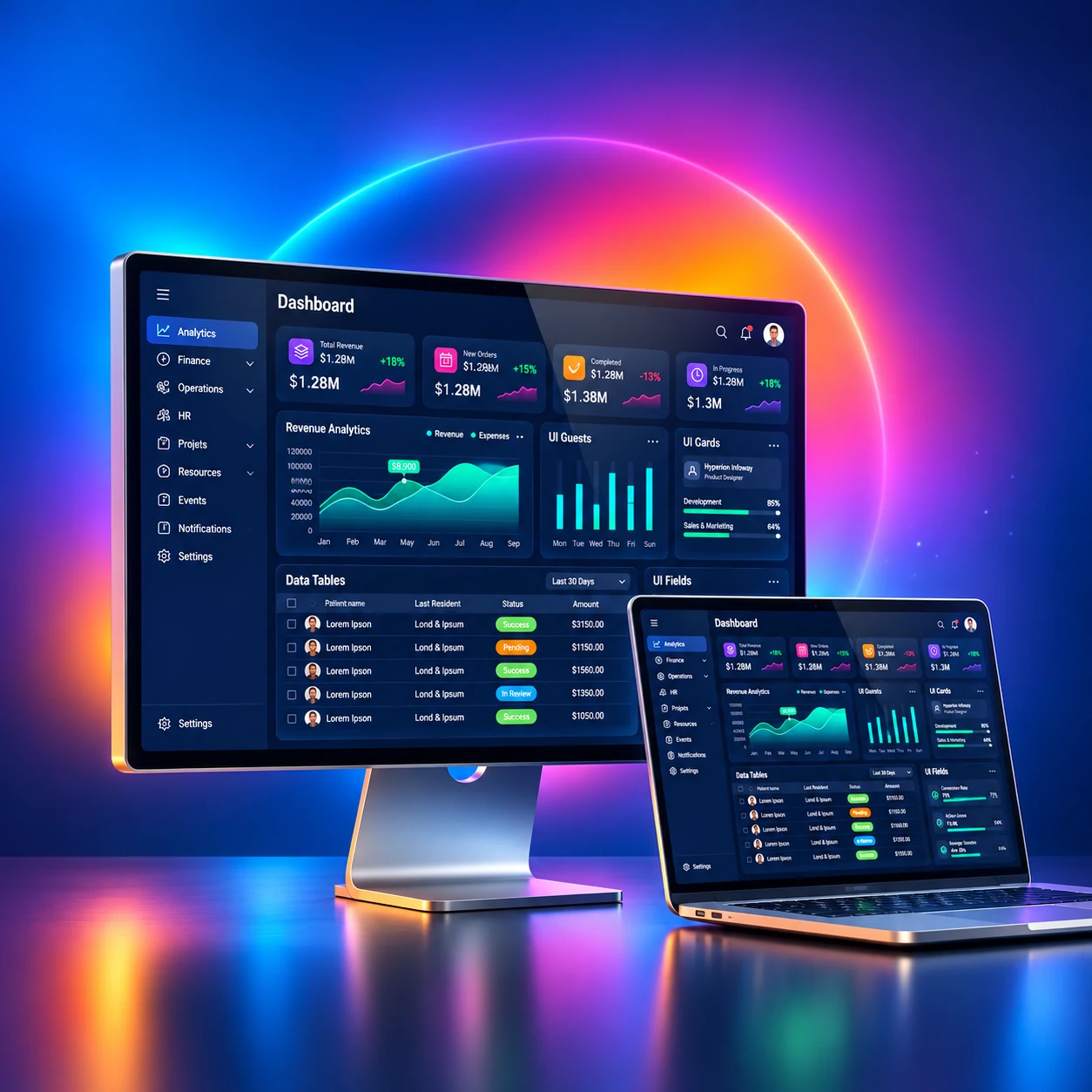
We engineer bespoke software systems that streamline your business workflows, unify fragmented company data, and automate daily operations with precision.
Every enterprise operates under its own distinct principles. One organization requires tracking complex B2B client inquiries; another prioritizes multi-warehouse stock accounting and wholesale shipments; a third needs to coordinate internal staff tasks within a single portal. As your business scales, managing these operations across disconnected Excel spreadsheets, messaging groups, and disjointed off-the-shelf software becomes a bottleneck that drains productivity.
At Codemark, we deliver custom software development designed around your organization's exact commercial needs. Through custom ERP and CRM systems, web applications, role-based dashboards, automated order engines, and bespoke business platforms, we help transform fragmented workflows into unified, efficient digital engines.
Our objective goes far beyond writing lines of code. We take the time to analyze how your business operates, identify operational bottlenecks, and craft durable digital solutions that bring tangible, measurable daily value to your enterprise.
We ensure every system we deploy is intuitive for your team, straightforward to administer, and architected to scale seamlessly alongside your future corporate growth.
Looking to build custom software for your company? Tell us about your organization. Let us examine your operational bottlenecks, discuss which processes you want to automate, and define the optimal technical architecture together.
What Does Custom Software Bring to Your Business?
In many enterprises, a substantial portion of daily tasks is still performed manually. Client details reside in scattered files, orders are accepted over phone calls and messaging chats, and staff spend hours manually compiling status reports for leadership.
While this approach may suffice for small teams early on, as client volume and transaction counts grow, tracking data, maintaining inter-departmental harmony, and overseeing execution becomes overwhelmingly complex.
Bespoke software organizes these operations into a unified, reliable, and transparent digital architecture.
For instance, when a sales representative logs a new commercial inquiry into the system, management can immediately view its progress pipeline stage. Once the order is signed, tasks are dispatched automatically to fulfillment, warehouse inventory is reserved, and notification triggers keep all departments synchronized.
The need to duplicate data across multiple documents or manually re-enter information between teams is eliminated. Data is governed from a single source of truth, removing discrepancies, lost leads, and administrative waste.
Another decisive advantage is actionable business intelligence. Company executives can monitor real-time sales pipelines, active order queues, team performance KPIs, and operational costs from an executive analytics dashboard.
Well-architected software simplifies daily workloads, eliminates redundant manual data entry, minimizes human error, and makes business management completely transparent.
Of course, implementing software does not automatically resolve operational hurdles on its own. For a system to deliver lasting value, business workflows must be carefully analyzed, features built around genuine daily needs, and staff adoption planned thoroughly.
Tailored Software Engineered for Every Enterprise
Even two enterprises operating in the same industry often function under completely different business models.
For instance, one wholesale distributor prioritizes tracking goods arriving at central depots, processing customer orders, and monitoring stock depletion. Another distributor manages dealer networks, multi-warehouse transfers, refrigerated logistics, and field rep commissions.
While a generic warehouse package might offer basic inventory sheets, satisfying both companies' specialized processes with a single rigid off-the-shelf product is rarely possible.
This is why the foundational stage of custom software development is understanding how your business actually runs.
Depending on your requirements, we may unify disparate workflows into an all-in-one platform, automate specific high-volume bottlenecks, or engineer a proprietary system from the ground up.
In other cases, modernizing existing platforms and establishing clean API connectors between legacy systems is the most cost-effective path. We believe you should never build from scratch when a modular enhancement achieves your goal.
What matters is choosing the architectural strategy that simplifies your company's work and optimizes your return on investment.
Which operations repeat daily? Where do employees lose the most hours? Where is company data currently stored? What software is in use? What new capabilities will you need as your workforce expands?
Answering these core questions shapes the scope of your software platform, ensuring capital is invested with high efficiency and the resulting system delivers maximum utility.
What Custom Software Systems Do We Build?
At Codemark, our custom software engineering spans varied enterprise systems and high-concurrency web platforms. Depending on your operational targets, we engineer internal management hubs, client-facing portals, automated booking engines, or specialized web platforms.
Enterprise Resource Planning (ERP) Systems
An ERP system is the digital backbone connecting various corporate departments and workflows into a unified platform.
As an enterprise expands, maintaining real-time communication between warehouse, sales, procurement, accounting, and leadership becomes increasingly complex.
For example, sales reps need to know real-time stock availability before signing deals; warehouse managers must see which items are reserved; executives want a high-level view of revenue and expenditures.
When this information is fragmented across disparate files, reconciliation wastes valuable hours. An ERP unites these operations into one coherent interface.
Our custom ERP development encompasses multi-warehouse inventory, procurement workflows, automated invoicing, employee task allocation, and real-time analytical reports tailored to your exact industry.
You only pay for features you actually use, avoiding the bloat and prohibitive licensing costs of rigid off-the-shelf mega-suites.
Customer Relationship Management (CRM) Systems
Organizing customer communication and managing sales pipelines is vital for maintaining a competitive commercial edge.
Inbound leads arrive via phone calls, emails, website forms, social ads, and partner referrals. Without a centralized hub, leads slip through the cracks and follow-ups are missed.
A CRM platform structures customer accounts, logs historical interactions, assigns deals to account managers, and tracks deals through each pipeline milestone.
Our custom CRM development includes lead scoring, automated reminder triggers, deal stages, and custom sales performance reports. To further optimize sales productivity, advanced AI solutions can be integrated for automated lead qualification and churn prediction.
A custom CRM aligns completely with your company's internal sales playbook rather than forcing your team to fit a rigid external template.
High-Concurrency Web Applications & Portals
A web application is a software platform accessed securely through modern web browsers that executes intricate operational logic.
Unlike basic informational websites, web applications feature multi-role user authentication, dynamic data processing, and complex business workflows.
Examples include multi-vendor supplier portals, client self-service hubs, and automated reservation platforms. Alongside the web platform, companion mobile app development can be engineered sharing the same central database for maximum user accessibility.
We engineer web applications using modern, battle-tested frameworks like Laravel, Node.js, and Next.js, prioritizing sub-second query response times and airtight data isolation.
Bespoke Corporate Systems & Automation Tools
Not every software requirement fits into traditional ERP or CRM definitions.
Many enterprises require a proprietary tool engineered around a unique internal workflow.
Examples include field service dispatchers, custom pricing calculators for manufacturing quotes, or student enrollment management systems for educational academies.
Our bespoke software engineering builds exactly the modules your team needs: custom calculations, automated PDF invoice generation, transactional SMS/email triggers, and real-time audit logs.
By focusing strictly on functional requirements, we deliver lean, fast, and highly reliable tools that solve operational challenges directly.
End-to-End Business Process Automation
Corporate operations involve hundreds of repetitive manual transactions daily.
Manually copying order details into spreadsheets, emailing warehouse staff, checking stocks, and compiling weekend reports is time-consuming and prone to costly human errors.
Business process automation delegates programmatic tasks to an automated system guided by established business rules.
When a client submits an order, the system automatically assigns an order ID, designates responsible team members, validates stock, updates balances, and issues client receipts.
Approval hierarchies can be integrated: when an order exceeds a certain threshold, the system routes an approval request directly to management before moving to fulfillment.
We focus on automating high-friction workflows that deliver tangible time savings and reduce human error, allowing your team to focus on strategic client growth.
Inventory & Multi-Warehouse Management Systems
For commercial enterprises dealing with physical goods, precise inventory visibility across multiple warehouses is critical.
Tracking which depot holds a product, batch expiration dates, supplier costs, and reserved quantities prevents stockouts and fulfillment delays.
Our custom inventory platforms track inbound shipments, inter-warehouse transfers, barcode scanning, minimum stock alerts, and automated reorder points.
Integration with billing engines ensures that whenever an order is fulfilled, inventory levels decrement instantly, preventing accidental double-selling.
Centralized Order & Inquiry Routing
Consolidating incoming orders and service requests from phones, website forms, WhatsApp, and physical walk-ins into a unified pipeline brings order to chaotic operations.
Staff can track inquiry stages from initial contact to quote generation, fulfillment, and post-service follow-up.
Executives can view overdue tickets, average resolution times, and team capacity at a glance.
Industry-Specific Software Solutions
Custom software development adapts to the unique workflows and regulatory standards of diverse industries.
Wholesale, Retail & Distribution
Wholesale and distribution enterprises benefit from structured product trees, tiered pricing by dealer level, warehouse tracking, and delivery routing.
Manage supplier accounts, consignments, and multi-branch inventory within a single unified platform.
Travel, Hospitality & Tourism
Track hotel vouchers, flight bookings, transfers, insurance, and custom tour packages in one interface.
Consolidate multi-currency payments, partner commissions, and net profit margins per itinerary.
Education, Academies & Training
Manage student admissions, classroom schedules, tutor payouts, attendance records, and tuition installment tracking.
Self-service student portals and automated SMS payment reminders improve administration efficiency.
Technical Maintenance & Field Services
Log maintenance tickets, dispatch field technicians, capture equipment serial numbers, and record customer sign-offs.
Maintain complete service histories for customer machinery and schedule preventive maintenance cycles.
Manufacturing & Industrial Operations
Manage raw materials, production batch tracking, bill of materials (BOM), quality control logs, and finished goods inventory.
Calculate true unit production costs and eliminate bottlenecks across assembly lines.
Consulting, Legal & Professional Services
Track client case files, billable hours, project milestones, retainers, and document archives securely.
Tailor workflows around confidential data handling and multi-party sign-offs.
Off-the-Shelf SaaS vs. Custom Software Engineering?
A major strategic question businesses face is whether to license pre-packaged SaaS tools or invest in custom software engineering.
There is no universal answer; the decision depends on functional complexity, data sovereignty, and long-term operating costs.
Off-the-Shelf Software (SaaS)
Ready-made platforms provide standard features out of the box, offering rapid deployment for basic customer databases or generic task management.
However, pre-packaged tools force your business to conform to their rigid conventions. Essential bespoke workflows often cannot be supported.
Furthermore, recurring per-seat monthly subscription fees grow exorbitant as your headcount expands, without you ever owning the underlying software assets.
Custom Software Engineering
Custom software engineering shapes every module, role, and calculation directly around your competitive advantages.
You gain total architectural control, zero per-seat licensing fees, full intellectual property ownership, and seamless integration with your existing infrastructure.
While custom engineering requires upfront development planning, it delivers vastly superior long-term ROI and operational autonomy for growing enterprises.
The decision should consider not just day-one setup costs, but 3-to-5-year total cost of ownership (TCO), proprietary data privacy, and strategic flexibility.
At Codemark, we evaluate your options objectively to recommend the most commercially viable path for your business.
Intuitive & Ergonomic Web Admin Dashboards
Functional power is only half the battle; ensuring your team can navigate the system easily and without errors is equally critical.
Cluttered menus and confusing input forms frustrate employees and decrease data entry accuracy.
We craft role-optimized interfaces: sales reps see active leads and call logs; warehouse workers see pick lists and stock counters; executives see high-level KPI summary cards.
Clean layouts, smart search, faceted filters, and responsive design make daily operations enjoyable and efficient.
Role-Based Access Control (RBAC) & Permission Security
Not every staff member should have unrestricted access to your entire company database.
Sales reps must view customer notes without viewing full corporate financial balances; junior clerks should create draft orders without permission to issue refunds or delete historical records.
We implement granular Role-Based Access Controls (RBAC) where permissions are configured by department and seniority.
Comprehensive audit logs record which user created, modified, or exported records, ensuring total corporate accountability.
REST / GraphQL APIs & Seamless External Integrations
Your custom software does not need to live on an island; it can seamlessly integrate with your existing corporate software ecosystem.
We engineer high-performance RESTful and GraphQL APIs that connect with accounting platforms (1C), bank acquiring gateways, electronic document services, transactional SMS, and messaging bots.
Data syncs in real time across systems, eliminating manual re-keying and preventing data discrepancies.
Actionable Reports & Real-Time Executive Analytics
For leadership, having instant visibility into company performance is essential for strategic decision-making.
Our custom software features dynamic visual reporting: revenue by department, sales velocity, average order values, and inventory turnover rates.
All reports support instant 1-click filtering and data export to Excel, CSV, or formatted PDF documents.
Enterprise Security, Encryption & Cloud Infrastructure
Your enterprise software holds proprietary business secrets, employee records, financial ledgers, and client lists. Data security is paramount.
We enforce two-factor authentication (2FA), TLS 1.3 encryption, secure bcrypt/argon2 password hashing, SQL injection sanitization, CSRF defenses, and automated encrypted daily database snapshots.
We can deploy your software to dedicated private cloud infrastructure (AWS, Google Cloud) or directly on-premise within your corporate server rooms.
Modular Architecture Engineered for Future Scale
Business priorities evolve. A system that addresses sales and orders today will likely need warehouse and procurement modules tomorrow.
We engineer clean, modular architectures that allow new capabilities, branches, and user groups to be added smoothly without disrupting active production workflows.
Your software platform expands organically alongside your enterprise growth.
How Does the Custom Software Development Lifecycle Work?
The foundation of a successful software engagement is meticulous requirements analysis before writing code. At Codemark, every project moves through a transparent 8-stage lifecycle.
1. Business Discovery & Process Audit
We begin by examining your day-to-day operations and organizational workflows.
How are tasks currently executed? Where are operational bottlenecks occurring?
We define what problems the software must resolve and establish clear success metrics.
2. Functional Scope & Technical Architecture
We document user roles, database schemas, workflow logic, and integration endpoints.
Every business rule and edge case is defined in a clear functional specification.
A transparent scope prevents scope creep and ensures predictable delivery schedules.
3. UI/UX Prototyping & Workflow Design
Our designers model the complete interactive interface in Figma.
Every form, data table, modal, and role dashboard is laid out for maximum clarity.
Your team reviews clickable prototypes to validate ergonomics before coding begins.
4. Backend & Database Engineering
Our engineering team translates blueprints into clean, robust production code.
Relational databases are structured, APIs built, and role authentication enforced.
We use enterprise frameworks like Laravel, Node.js, and PostgreSQL for maximum stability.
5. QA & Multi-Scenario Testing
We execute rigorous unit, integration, role permission, and high-load stress tests.
Calculations, report outputs, payment gateways, and data integrity are thoroughly validated.
All identified edge case bugs are resolved prior to production deployment.
6. Production Deployment & Data Migration
The system is deployed onto secure dedicated cloud servers or corporate on-premise environments.
Existing legacy records (Excel tables, old databases) are sanitized and migrated safely.
Production environment monitoring, firewalls, and automated backups are initiated.
7. Staff Walkthroughs & User Training
We conduct structured training walkthroughs for your department managers and staff.
User guides and administrative documentation ensure smooth onboarding across your organization.
We remain on close standby during early adoption to answer questions immediately.
8. Continuous SLA Support & Scaling
Following deployment, we provide ongoing maintenance to ensure uninterrupted system uptime.
Dependable ongoing software maintenance and support guarantees security patching, server optimization, and future feature sprints.
What Factors Determine Custom Software Development Costs?
Cost is naturally a primary consideration when evaluating bespoke software development.
However, quoting an arbitrary fixed price without analyzing project specifications is impossible because functional scope, security requirements, and data depth vary widely across businesses.
A focused internal order tracker requires very different development resources than an all-in-one multi-branch ERP managing inventory, 1C sync, and dozens of user roles.
Software pricing is primarily driven by functional scope, technical complexity, user role hierarchies, third-party integrations, and legacy data migration needs.
Functional Scope & Depth
The number of interactive workflows, automated calculation formulas, and approval hierarchies directly determines engineering and testing hours.
User Roles & Permissions
Configuring granular access permissions across multiple staff groups (admins, branch managers, accountants) adds architectural considerations.
External Integrations
Connecting with 1C, banking APIs, SMS gateways, and corporate ERPs requires specialized data schema mappings and webhook configurations.
Legacy Data Migration
Sanitizing, converting, and safely importing years of historical company records from spreadsheets or older databases requires dedicated migration scripts.
UI/UX Customization
Bespoke visual dashboards, complex relational data trees, and customized report builders require tailored design attention.
Infrastructure & Maintenance
Dedicated cloud server hosting, automated backup tiers, and ongoing SLA maintenance agreements are clearly factored into project plans.
At Codemark, we believe in transparent, value-based scoping. By prioritizing core operational priorities first and scaling iteratively, your capital is deployed with maximum efficiency.
Want to receive a detailed technical proposal for your software project? Send us an outline of your operational requirements today.
How Long Does It Take to Build Custom Software?
Development timelines correlate directly with functional scope and architectural depth.
A focused departmental management tool typically requires 4–8 weeks, whereas a comprehensive multi-module ERP or custom financial engine spans 3–6 months.
A decisive factor is clarity of specifications: having well-documented internal business rules enables rapid sprint execution.
We provide committed sprint deliverables and milestone schedules during discovery so your launch roadmap is predictable.
What Happens After Software Implementation?
Deploying the system into production is a major milestone, but ongoing organizational success requires continuous refinement.
As your team works with the software daily, opportunities to enhance forms, introduce automated shortcuts, and build new custom reports will emerge.
Our ongoing support plans cover system health monitoring, database optimization, framework updates, and dedicated sprint hours for iterative functional enhancements.
Regional Standards & Global Engineering Best Practices
Whether partnering with companies in Baku, across Azerbaijan, or with international organizations in Europe and the Middle East, our delivery workflow is transparent and collaborative.
We understand regional commercial practices, taxation and invoicing workflows, local bank protocols, and multilingual requirements, while applying world-class software architecture standards.
Why Choose Codemark for Custom Software Development?
When selecting a software development partner, technical buzzwords matter far less than business acumen and architectural reliability.
At Codemark, we approach software development from a business perspective: analyzing your operational model, team workflows, and commercial objectives before proposing architecture.
We build clean code without proprietary vendor lock-in, transfer complete intellectual property ownership upon completion, and support your long-term digital evolution.
Our philosophy is straightforward: your software must run reliably, empower your workforce, and deliver measurable corporate efficiency.
Frequently Asked Questions About Software Development
Let's Engineer the Right Software Solution for Your Business
Whether you want to eliminate chaotic spreadsheets, streamline customer pipelines, or unify departments into a single enterprise system, bespoke software provides the foundation for sustainable scale.
Not every company requires a sprawling system on day one. Often a focused, high-impact module brings immediate commercial relief.
What matters is choosing an architecture designed specifically around your operational priorities.
If you are ready to explore custom software development for your organization, connect with our engineering team today.